


[The Following work was put into electronic format by Patsy Jackson for
Tentmaker Publications]
Hutchinson & Co. (Publishers) Ltd.
London : New York : Melbourne : Sydney
DEDICATED
TO
The Right Honourable
LORD VANSITTART OF Denham, p.c.,
IN RESPECT, GRATITUDE, AND FRIENDSHIP
MADE AND PRINTED IN GREAT BRITAIN
AT GAINESBOROUGH PRESS ST. ALBANS,
BY FISHER, KNIGHT & CO., LTD
“I do insist on the certainty that sooner or later—once we hold power—Christianity will be overcome and the German church, without a Pope and without the Bible, and Luther, if he could be with us, would give us his blessing.” ——Adolf Hitler, (“Hitler’s Speeches”, edited by Professor N. H. Baynes (Oxford, 1942), page 369).
“If we wish to find a scapegoat on whose shoulders we may lay the miseries which Germany has brought upon the world—not, perhaps a very scientific way of writing history—I am more and more convinced that the worst evil genius of that country is not Hitler or Bismarck or Frederick the Great, but Martin Luther.” …and…
“There is very little to be said for this coarse and foul-mouthed leader of a revolution. It is a real misfortune for humanity that he appeared just at the crisis in the Christian world. Even our burly Defender of the Faith was not a worse man, and did far less mischief. We must hope that the next swing of the pendulum will put an end to Luther’s influence in Germany.” ——Very Rev. W. R. Inge, (in the Church of England Newspaper”, August 4, 1944).
“It is easy to see how Luther prepared the way for Hitler.” ——The late Dr. William Temple, Archbishop of Canterbury (“The Archbishop’s Conference, Malvern, London, 1941, page 13).
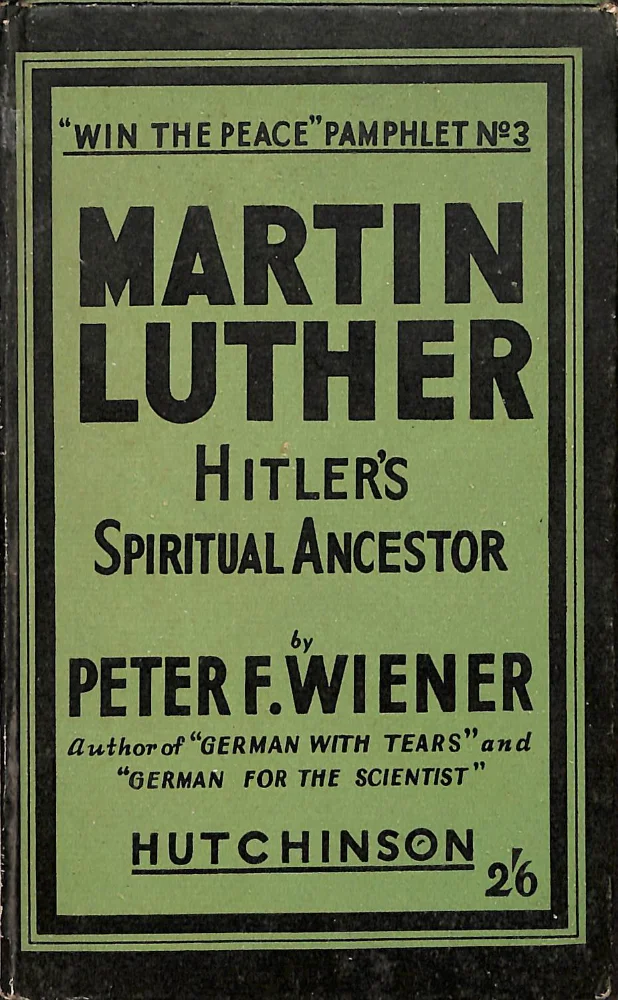
[Editor’s note (2026) to the reader: Written in the closing months of World War II, Martin Luther: Hitler’s Spiritual Ancestor by Peter F. Wiener is a short but provocative work drawing on Luther’s own letters and writings to examine the darker side of the Reformer — his virulent antisemitism, his calls for absolute obedience to the state, and his demand for the violent suppression of the German peasants. Wiener’s central argument is that these elements of Luther’s thought created a cultural and ideological climate in Germany that Hitler would later exploit. The book closes with an essay titled “From Luther to Hitler,” tracing that thread directly.
The book prompted an immediate rebuttal from Reformation scholar Gordon Rupp (Martin Luther: Hitler’s Cause — or Cure?, 1945), and remains a thought-provoking, if intentionally one-sided, entry point into a question that serious historians continue to wrestle with: to what degree did Luther’s legacy prepare the ground for National Socialism?]
